What do Swiss companies need to know about the Packaging and Packaging Waste Regulation?
What do Swiss companies need to know about the Packaging and Packaging Waste Regulation?
The Packaging and Packaging Waste Regulation (PPWR) applies to all companies placing packaging on the EU market, including Swiss companies. Under the regulation, any company supplying packaged products on the EU market must provide stricter evidence that its packaging is recyclable, free from dangerous substances and correctly labelled, and must maintain appropriate documentation. Against this background, companies need to understand the requirements early and request information from suppliers to ensure compliance.
Key points of the PPWR
The PPWR replaces the existing European Packaging and Packaging Waste Directive (PPWD), introducing more comprehensive and harmonised requirements for packaging across the EU. This regulation affects every economic operator (brand owners, importers, retailers, e-commerce providers and packaging manufacturers) along the packaging supply chain that place products on the European market.
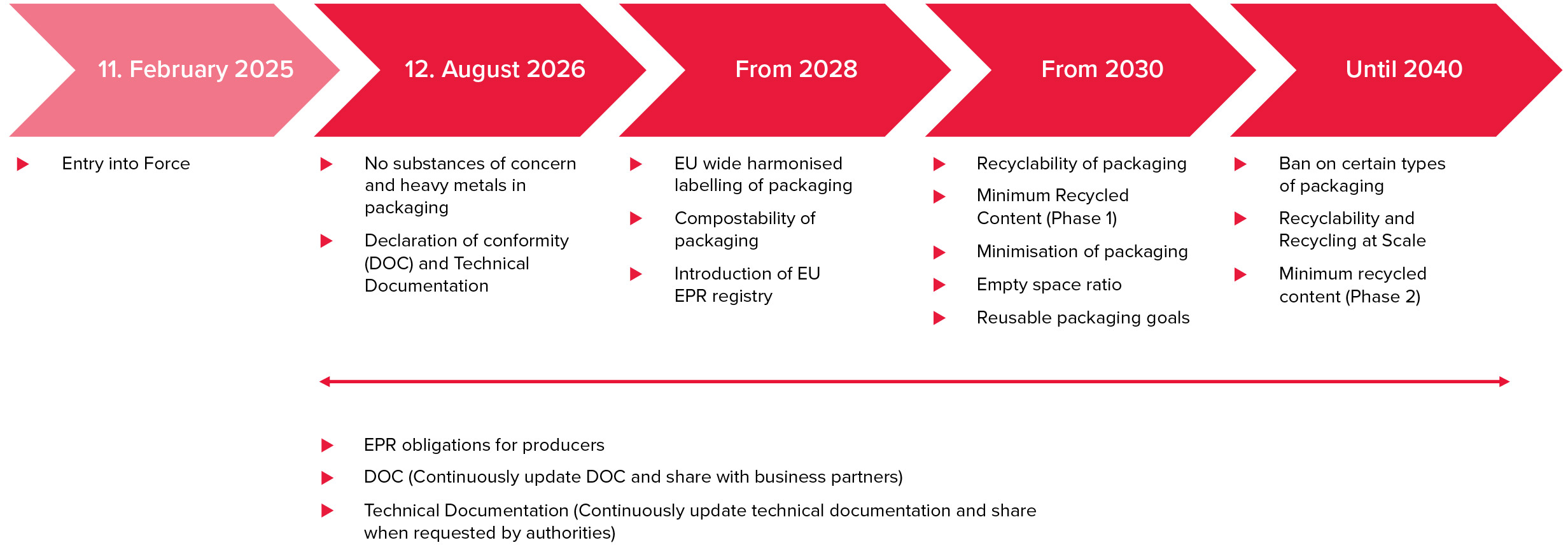
The PPWR is generally applicable with effect as of 12 August 2026. From 2030 onwards, further key requirements will come into force, including those relating to recyclability, recycled content and packaging minimisation.
Companies should clarify now which packaging is affected, what role they play in the supply chain and what evidence they need to provide to customers, importers or trading partners.
Why is the PPWR relevant?
Packaging has been subject to increasing regulatory pressure in the EU for years. The PPWR is more than just environmental regulation. It links sustainability, product design, supply chain data, labelling and market access.
The EU is pursuing three main objectives with this regulation: reduce packaging waste; cut down on use of virgin raw materials in packaging production; and make packaging easier to recycle. In addition, the EU is seeking to reduce national packaging rules and harmonise requirements more closely within the EU single market.
Breaches of the PPWR can lead to fines, product recalls and restrictions on access to the European market.
Who is affected by the PPWR?
The PPWR applies to economic operators along the packaging value chain. The decisive factor is therefore not solely the location of a company’s registered office, but whether packaging or packaged products enter the EU. This means that even non-EU companies are affected by this regulation of they place products in the EU market.
The regulation defines specific roles for individual stakeholders, although a company may fulfil several roles in parallel. The respective compliance obligations depend on the role within the supply chain. Accordingly, companies should clearly identify their role(s) within the supply chain.
The primary roles defined under the PPWR are:
- Suppliers – companies that manufacture empty packaging or packaging materials for other economic actors.
- Manufacturers – companies that place their brand or trademark on packaging, or that commission packaging designed to meet the specifications of their products. Manufacturers are subject to the broadest range of compliance obligations under the PPWR.
- Importers – companies established within the EU that import packaged products from third countries into the EU market.
- Distributors – companies, other than manufacturers or importers, that make packaging or packaged products available on the market, e.g. traders and logistics providers.
- Final distributors – companies that sell or deliver packaged products directly to end consumers, such as retailers and e-commerce businesses.
- Producers – companies placing packaged products on the market in an EU Member State where the packaging ultimately becomes waste. A producer may be a manufacturer, importer, distributor or final distributor, depending on the circumstances. Producers are responsible for fulfilling Extended Producer Responsibility (EPR) obligations, including the payment of EPR fees in each applicable Member State.
Companies based outside the EU need to examine their situation particularly carefully. Depending on their business models, obligations may lie directly with the EU importer; in practice, however, data, documents and evidence may be required from the non-European companies. Anyone supplying goods to the EU should therefore not wait until customers or authorities make enquiries.
Micro-enterprises with fewer than 10 employees and annual turnover of less than EUR 2 million are exempt from certain PPWR requirements.